







Key Takeaways
- PII detection tools help organizations identify, classify, and protect sensitive data across file shares, cloud storage, databases, emails, and AI workflows.
- The most important capabilities in 2026 include OCR support, AI readiness, automated classification, Microsoft Purview integration, and support for unstructured data.
- Different PII scanning tools are designed for different use cases, from Microsoft 365 governance and insider-risk management to enterprise data cataloging and compliance-driven discovery.
- Organizations handling regulated data should carefully evaluate deployment models, including cloud, hybrid, on-premises, and air-gapped environments.
- The best PII detection tool is the one that aligns with your security requirements, compliance obligations, and data infrastructure.

Organizations today are generating and moving unstructured data at an unprecedented scale. Personal information is no longer confined to isolated databases. Instead, it’s actively scattered across network file shares, cloud storages, archived mailboxes, scanned PDFs, and AI model workflows.
Whether your team is auditing infrastructure for GDPR, HIPAA, PCI DSS 4.0, or the EU AI Act, the fundamental prerequisite remains identical: You cannot secure, encrypt, or govern sensitive information you cannot find.
This visibility gap has turned selecting a PII detection tool or PII scanning tool into a high-stakes decision. However, the market is flooded with conflicting software categories, ranging from cloud-heavy DevOps logging platforms to massive database catalogers.
This guide evaluates the leading PII scanning tools in 2026, mapping their technical architectures to specific enterprise use cases so you can deploy what actually works.
Comparison: 2026 PII Scanning Capabilities
To make the comparison easier, we've evaluated each platform against the criteria most commonly considered during modern privacy, compliance, and AI-governance initiatives.
| Feature / Capability | PII Tools | Microsoft Purview | Varonis | BigID | Spirion |
|---|---|---|---|---|---|
| Primary Deployment | Private Cloud, On-prem, or hybrid ✅ |
Cloud SaaS only 😐 | Hybrid / Cloud-heavy 😐 | Multi-Cloud SaaS | Hybrid / On-prem ✅ |
| Data Egress Model | Zero data egress by design ✅ |
M365 cloud ecosystem 😐 | Hybrid 😐 | Cloud-centric 😐 | Hybrid 😐 |
| Native Image OCR | Built-in (400+ formats) ✅ | Limited / Add-on ❌ | Basic 😐 | Cloud-dependent 😐 | Limited ❌ |
| Downstream DLP Fueling | Yes (native integration)✅ | Yes (built-in)✅ |
Yes (internal policy) ✅ | Yes (catalog sync) ✅ |
Yes ✅ |
| Air-Gapped Operation | Fully Supported✅ | No ❌ | No ❌ | No ❌ | No ❌ |
| AI & Copilot Readiness | Remediate sensitive data for AI workflows and LLMs ✅ | Strong within Microsoft Copilot ecosystem😐 | Limited AI-specific focus 😐 | Strong data inventory foundation for AI governance✅ | Primarily traditional classification workflows😐 |
| Licensing Model | Predictable Flat / Repo ✅ | Per-user E5 Tiers 😐 | Complex enterprise😐 | Volume / Data source😐 | Node / Endpoint😐 |
PII Detection Tools: Full Breakdown
1. PII Tools: The Air-Gapped Gold Standard
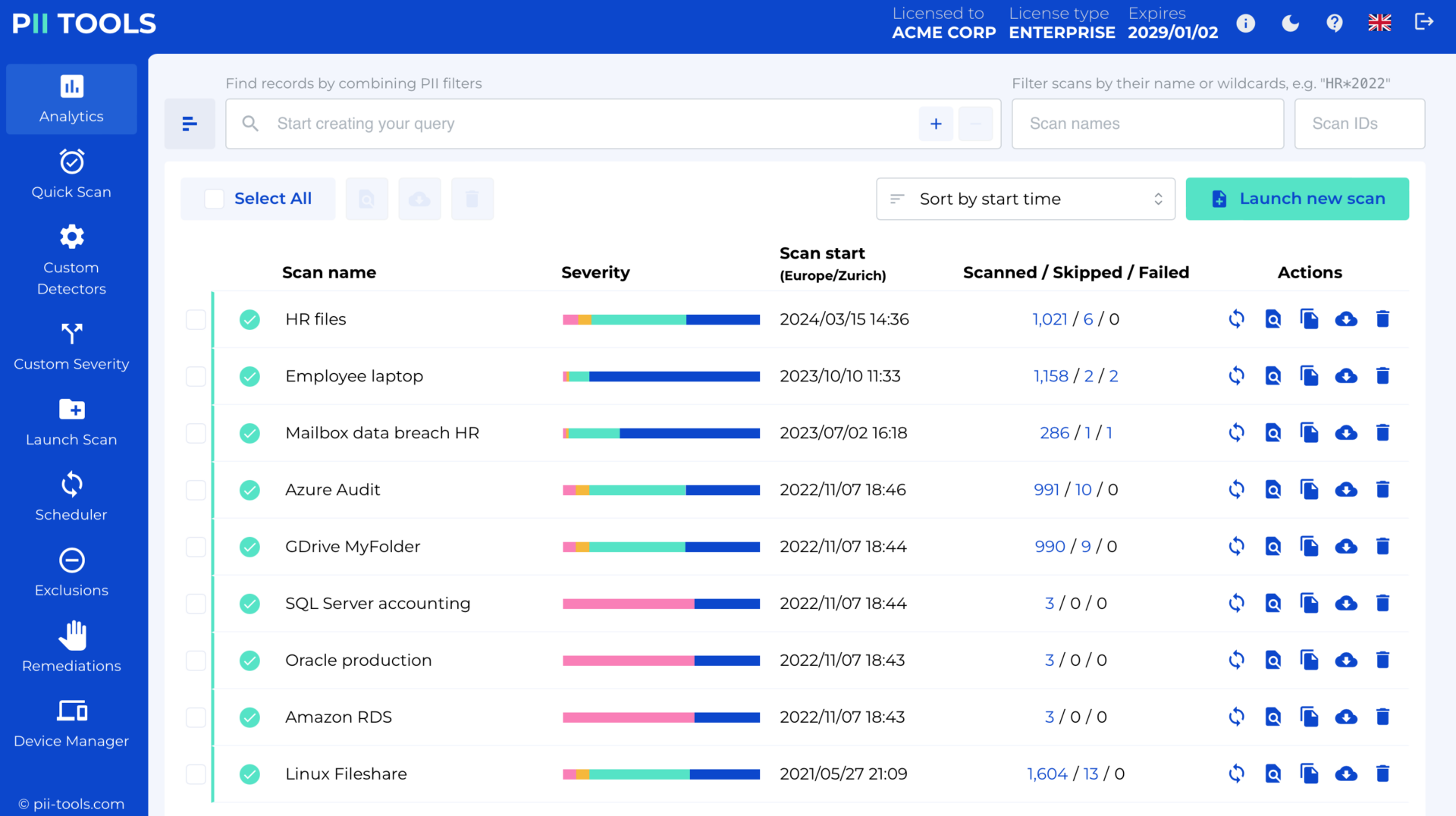
PII Tools is engineered strictly for self-contained, highly accurate data discovery and deep infrastructure mapping. While other platforms bundle discovery as a secondary module inside a larger governance framework, PII Tools treats automated discovery as a standalone core competency.
- Zero-Data-Egress Architecture: The entire engine deploys locally or within strictly isolated, air-gapped networks. Files are interrogated 100% within your secure boundary (private cloud, on-prem), meaning regulated client or patient data never streams to a third-party vendor cloud to be scanned.
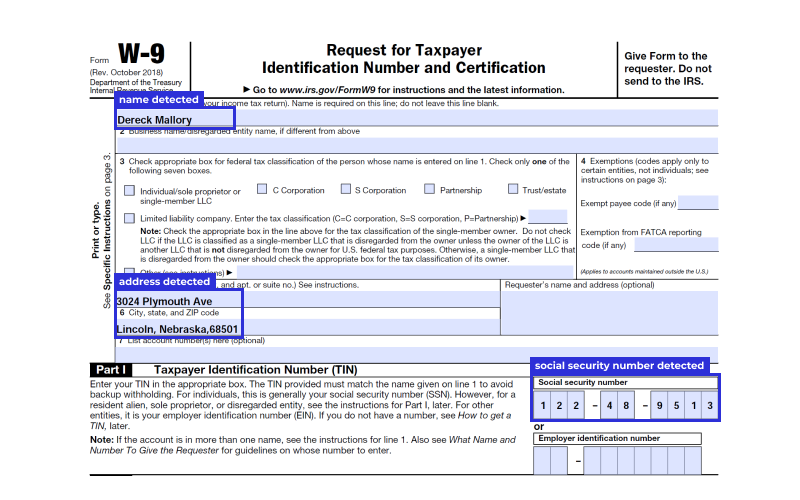
- Advanced OCR Mastery: It processes over 400 file formats out of the box. By pairing deep Optical Character Recognition (OCR) with AI-powered data classification, it natively reads text buried inside image-based PDFs, legacy faxes, and scanned intake forms that completely blind traditional keyword scanners.
- DLP Optimization: Rather than forcing you to rip and replace existing investments, it serves as a high-accuracy discovery layer that feeds clean, verified data directly into Microsoft Purview or corporate DLP policies, eliminating false positives from the start.
2. Microsoft Purview: The Ecosystem Choice
Microsoft Purview is an expansive data governance and compliance suite built natively into the Microsoft cloud platform.
- Where It Succeeds: For businesses whose operations exist entirely within the Microsoft 365 tent (SharePoint, OneDrive, Exchange), Purview provides automated sensitivity labeling and data loss prevention out of the box.
- Where It Struggles: Purview is inherently cloud-centric and heavily optimized for Microsoft-native formats. If your network relies on legacy on-premises file servers, non-Windows local endpoints, or massive volumes of unstructured, scanned image documents, configuring Purview to find this "dark data" introduces significant configuration complexity and licensing overhead.
3. Varonis: The Access Governance Specialist
Varonis is a massive Data Security Platform (DSP) built primarily to manage user permissions, monitor file activity, and mitigate insider risks.
- Where It Succeeds: Varonis excels at evaluating identity risk and file system hygiene. It provides immediate clarity on who has access to specific network folders, which permissions are overprivileged, and when anomalous file downloads occur.
- Where It Struggles: Because its platform is designed to monitor live activity across active directories, its scanning engines can be resource-intensive. For organizations that need to build an accurate PII inventory across deep archives without deploying massive background monitoring agents, Varonis can introduce unnecessary infrastructure weight and enterprise-tier pricing.
4. BigID & Spirion: Enterprise Cataloging and Legacy Classification
BigID and Spirion represent traditional data cataloging and discovery frameworks tailored for distinct operational scales.
- BigID: Built as a broad data intelligence platform, BigID is useful for sprawling multi-cloud enterprises that need to build an extensive data catalog of metadata across dozens of disparate corporate databases and cloud applications. However, it requires a significant engineering footprint to maintain and relies on cloud routing for heavy file processing.
- Spirion: A long-standing player in the sensitive data discovery space, Spirion focuses heavily on endpoint scanning and structured classification rules. While effective for classic desktop auditing, its architectural evolution into hybrid cloud models has diluted its ability to deploy as a simple, lightweight, pure on-premises discovery tool inside highly restricted, air-gapped environments.

Avoid the TOP 3 Mistakes
When comparing a PII detection tool, checking off vendor feature lists isn’t enough. To protect your organization from real-world data leaks and regulatory penalties, avoid these three architectural traps:
- The Cloud-Scanning Data Egress Trap
Many modern SaaS-based PII scanning tools require you to establish cloud connectors that pull your files into their hosted infrastructure for analysis. For companies operating under strict sovereign data mandates or HIPAA privacy laws, moving unmapped sensitive records outside your perimeter to scan them creates a massive, unnecessary attack surface. True security requires a tool that brings the logic to the data, not the data to the logic.
- Blindness to Non-Textual Unstructured Data
A massive percentage of corporate PII is stored as dark data including scanned onboarding documents, insurance cards, physical intake forms, and invoice PDFs. If your scanning solution relies purely on text-string regex patterns without a dedicated, high-speed OCR layer, your data inventory is fundamentally incomplete, leaving massive liabilities completely unmonitored.
- Annual Checkboxes vs. AI-Driven Velocity
With employees continuously exporting financial spreadsheets, uploading files, and feeding corporate data into generative AI workflows (like Copilot or ChatGPT), a point-in-time compliance audit is obsolete the moment it finishes. Organizations need an automated, continuous scanning cadence to ensure data remains accurately labeled and compartmentalized in real time.
Final Thoughts: Balancing Security and Architecture
Choosing the right PII detection tool is a foundational step in securing your organization's sensitive data. While different platforms take varied approaches to data discovery, the most important factor is selecting a solution that aligns with your infrastructure, security requirements, and compliance obligations.
A successful data protection strategy should prioritize:
- Deployment flexibility: Support for Private Cloud, Hybrid, On-Premises, and Air-Gapped environments.
- Unstructured data visibility: Native OCR and advanced classification capabilities to identify sensitive information hidden inside scanned documents, image files, and other forms of dark data.
- Workflow integration: The ability to feed accurate discovery results into Microsoft Purview, DLP policies, compliance programs, and AI governance initiatives.
Ultimately, the goal is to establish continuous visibility into your personal data without introducing new security risks during the discovery process itself.
Stop Exposing Data to Third Parties or Risky AI Models – Click the Button Below to Experience PII Tools for FREE ⬇️
Frequently Asked Questions (FAQ)
What is the primary difference between a PII detection tool and data classification?
PII detection is the foundational process of locating and identifying where sensitive records (like SSNs, medical IDs, or financial data) reside across your network. Data classification is the subsequent process of categorizing those discovered files based on their risk level (e.g., Public, Confidential, Restricted) and applying appropriate security labels.
What is the best PII detection tool for Microsoft Purview?
If you already use Microsoft Purview, a dedicated discovery tool like PII Tools can complement native discovery capabilities by identifying sensitive data in unstructured files, scanned documents, and legacy repositories before labels and DLP policies are applied.
Why is native OCR critical for a PII scanning tool?
Standard data discovery software can only read digital text layers. Scanned paper records, identity documents, faxes, and image-based PDFs are saved purely as pixel maps, making them invisible to traditional text search scripts. Built-in Optical Character Recognition (OCR) translates those visual elements into machine-readable text so hidden PII can be accurately flagged.
Can PII Tools deploy inside an air-gapped network?
Yes. PII Tools supports Private Cloud, Hybrid, On-Premises, and fully Air-Gapped deployments. Organizations can choose the deployment model that best fits their security and compliance requirements while maintaining complete control over sensitive data and ensuring zero data egress.
How does automated PII discovery assist with the EU AI Act and generative AI compliance?
Before allowing employees to upload corporate data blocks into Large Language Models (LLMs) or internal AI assistants, companies must ensure that personal data is completely scrubbed or redacted. Automated PII scanning tools provide the necessary upstream filtering to locate and sanitize hidden PII before it enters an AI model training pipeline.