







Key Takeaways
- Microsoft Purview focuses on enterprise information governance and downstream compliance policy enforcement.
- PII Tools specializes in deep sensitive data discovery, file analysis, and automated remediation.
- PII Tools natively supports secure and fully air-gapped deployments via Private Cloud, hybrid, and on-premises, with zero data egress.
- Built-in native OCR automatically exposes hidden unstructured PII inside scanned documents, faxes, and image files.
- Many organizations maximize security by using both platforms together, leveraging PII Tools to automate Purview sensitivity labels accurately.
Microsoft Purview & PII Tools
Microsoft Purview is often the natural starting point for organizations already invested in Microsoft 365. However, as enterprise data expands into Private Cloud environments, hybrid infrastructure, legacy repositories, and vast collections of unstructured files, many organizations discover they need deeper discovery capabilities than a governance platform alone is designed to provide.
The question isn’t whether Purview is a capable suite – it is. The question is whether its native PII detection tools are architecturally optimized to surface dark data, or if your security strategy requires a dedicated discovery layer like PII Tools to accurately fuel downstream sensitivity labeling and Data Loss Prevention (DLP).
The Core Architectural Differences
1. Deployment Flexibility and Data Egress
Microsoft Purview is inherently a public cloud SaaS product. While it offers hybrid connectors, its core scanning processes and data cataloging are structurally bound to the Microsoft cloud ecosystem. For highly regulated industries handling sovereign data, routing unmapped files outside your local perimeter introduces unnecessary security and compliance risks.
Conversely, PII Tools is designed for absolute infrastructure isolation. It deploys natively within your own secure Private Cloud, fully isolated on-premises infrastructure, or a hybrid of both. Because the scanning engine runs entirely inside your established network boundary, it ensures zero data egress by design, keeping all file processing under your direct operational control.

2. Detection Accuracy and the OCR Blind Spot
When mapping dark data, Purview combines multiple detection techniques, including sensitive information types, trainable classifiers, and OCR. However, organizations with large volumes of legacy, image-based, or highly unstructured data often require deeper discovery engines specifically optimized for those repositories.
PII Tools pairs advanced machine-learning classification with a native high-speed OCR engine. Supporting more than 400 file formats, it transforms image-based content into searchable text while accurately identifying hidden sensitive information that would otherwise remain difficult to classify at scale.
3. Headcount Licensing vs. Flat/Repo Pricing
The financial models of these platforms also heavily impact the long-term scalability of your security strategy. Microsoft gates its advanced auto-labeling and exact data matching (EDM) behind its highest E5 Tiers.
Because licensing is charged per user, per month, upgrading thousands of employee seats just to unlock compliance tools creates an exponential cost scaling factor tied to a headcount rather than the actual data infrastructure.
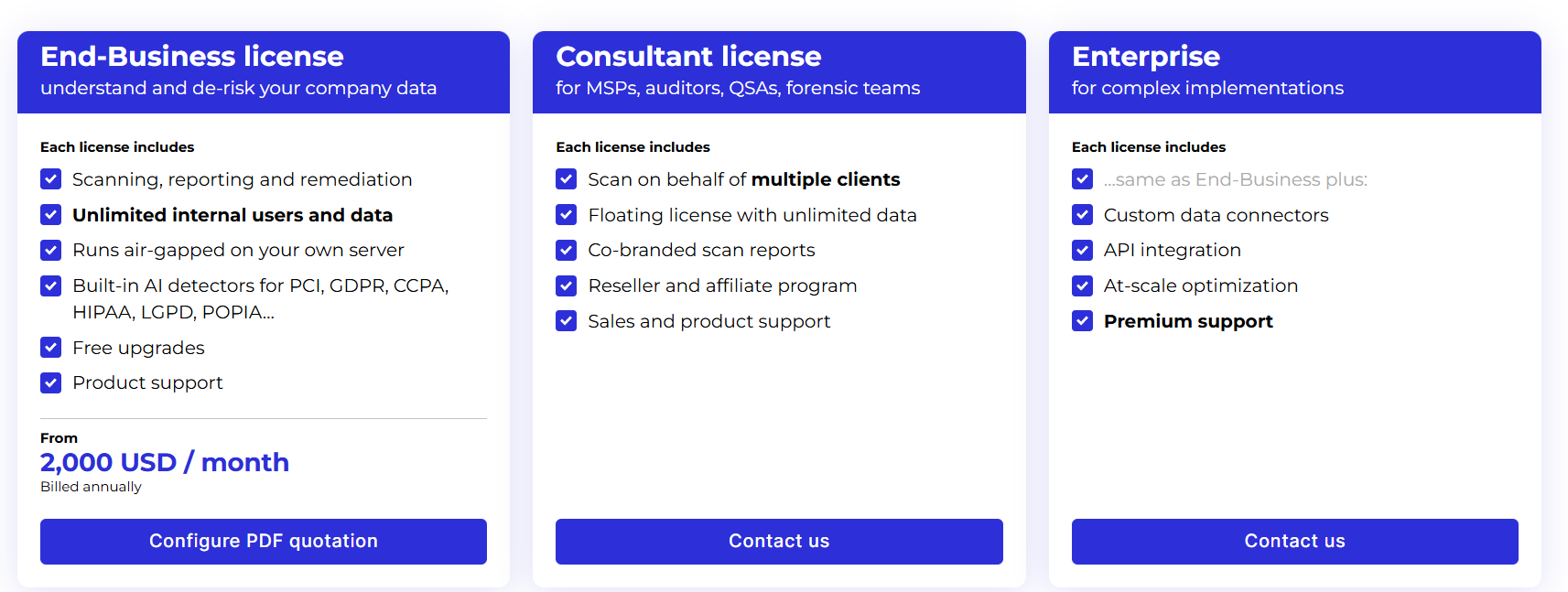
PII Tools utilizes a predictable Flat/Repo pricing model. You are licensed strictly based on the number of data repositories connected to the system, such as a specific database, a cloud storage bucket, or a network file share. This means software costs remain completely stable regardless of employee growth or log traffic spikes.
Better Together: Elevating Purview with PII Tools
Many enterprises achieve the strongest security posture by using both platforms simultaneously to eliminate manual review.
Microsoft Purview’s core strength is downstream enforcement, seamlessly applying encryption and restricting sharing based on established sensitivity labels. However, an enforcement policy is only as good as the discovery data fueling it. If Purview misclassifies or misses an image document entirely, your corporate DLP strategy fails.
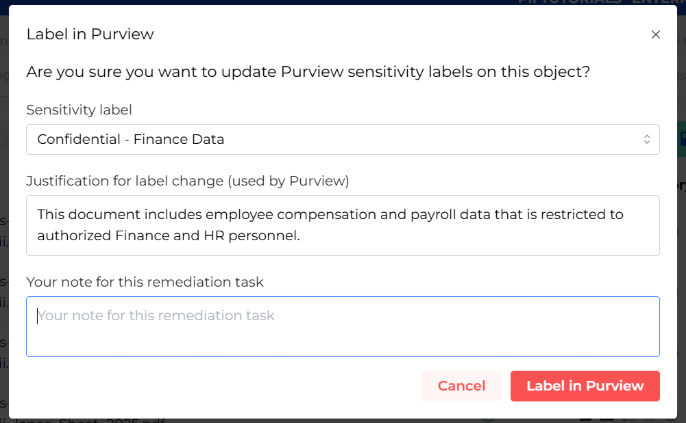
PII Tools acts as the high-accuracy, upstream discovery engine for Microsoft Purview:
- Discover: PII Tools scans your entire infrastructure, including complex legacy file shares, deep databases, and unstructured image profiles across your Private Cloud or on-premises networks.
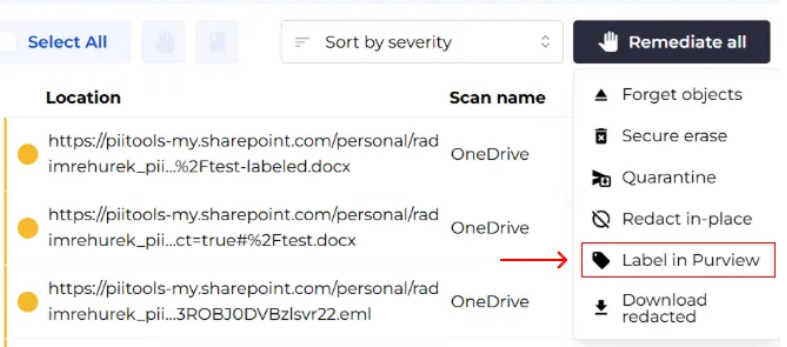
- Classify: Using native OCR and machine learning, PII Tools accurately flags hidden data and instantly embeds the precise Microsoft sensitivity label metadata directly into the files in bulk.
- Protect: Microsoft Purview instantly recognizes these pre-applied metadata tags and automatically executes your established downstream encryption, file tracking, and sharing restriction rules.
This hybrid approach allows you to fix the labeling blind spots that break traditional DLP rules while radically reducing Purview’s manual configuration overhead.
Balancing Security and Architecture
A successful data protection strategy relies on deployment flexibility across Private Cloud or air-gapped networks, deep visibility into unstructured files via native OCR, and seamless workflow integration to feed downstream tools like Microsoft Purview.
Ultimately, the goal is to achieve continuous visibility into your personal data without introducing new security or data egress risks during the discovery process itself.
By keeping your data discovery engine entirely within your secure perimeter, you eliminate compliance blind spots without exposing sensitive assets to third parties.
Schedule a PII Tools DEMO Today to See How Automated, Isolated Discovery Can Support Your Enterprise Security, Compliance, and AI-readiness Initiatives.
Frequently Asked Questions (FAQ)
- Is Microsoft Purview a PII discovery tool?
Partially. Purview includes sensitive information detection, but its primary focus is governance and protection within the Microsoft ecosystem. Organizations requiring deep discovery across large unstructured repositories or non-Microsoft environments often supplement it with a dedicated discovery platform.
- Can PII Tools integrate with Microsoft Purview?
Yes. PII Tools features native integration to automatically embed sensitivity labels directly into file metadata based on discovered content. Purview then reads these tags to enforce downstream data protection, access controls, and encryption policies.
- Which solution is better for on-premises or isolated environments?
PII Tools is purpose-built for Private Cloud, hybrid, on-premises, and fully air-gapped deployments. Organizations with strict data sovereignty requirements prefer this model because it ensures zero data egress by running entirely on your own infrastructure.
- Does PII Tools support OCR?
Yes. PII Tools includes a native, high-performance OCR engine, allowing sensitive data to be accurately detected inside scanned PDFs, legacy faxes, and image files across 400+ formats that otherwise remain hidden from text-only scanners.
- What is PII Tools?
PII Tools is sensitive data discovery software, so you can discover, analyze, and remediate PII across all your digital assets, on premises or on your Private Cloud. Schedule a FREE DEMO and secure your PII for good!