







Key takeaways
- AI privacy requires more than prompt filtering. Sensitive data must be protected before and during AI processing.
- Different tools address different risks. Discovery, DLP, runtime filtering, and tokenization serve distinct purposes.
- PII Tools specializes in enterprise data discovery. It detects and helps remediate PII across 400+ file formats, including scanned and handwritten documents.
- Choose tools based on your environment. Consider your AI workflows, infrastructure, and deployment requirements.
- Test before committing. Evaluate detection accuracy, unstructured data support, and data residency using real-world datasets.

Compare TOP 6 Data Protection Tools
Generative AI introduces new data privacy risks. When employees share corporate data with large language models (LLMs) or connect internal repositories to AI applications, personally identifiable information (PII) can be exposed to unauthorized users and third-party services.
Protecting PII requires more than filtering AI prompts. Organizations must discover sensitive data, control what enters AI workflows, and prevent unauthorized disclosure. In this guide, we compare six leading PII protection tools in 2026, including their strengths, limitations, and ideal use cases.
Why PII Protection in AI Applications Matters
Sensitive information can enter AI workflows through training datasets, uploaded documents, employee prompts, connected databases, or internal knowledge repositories. Without appropriate safeguards, this creates several risks:
- Training data exposure: PII may enter datasets used to train or fine-tune AI models, making subsequent removal difficult.
- Prompt leakage: Employees may unintentionally submit customer records or confidential information to external AI services.
- RAG vulnerabilities: AI assistants may retrieve sensitive documents and disclose information to unauthorized users.
- Unstructured data blind spots: Scanned PDFs, images, and handwritten records can contain PII that conventional text-based detection misses.
- Data retention risks: Sensitive information may persist in application logs, AI outputs, or downstream systems.
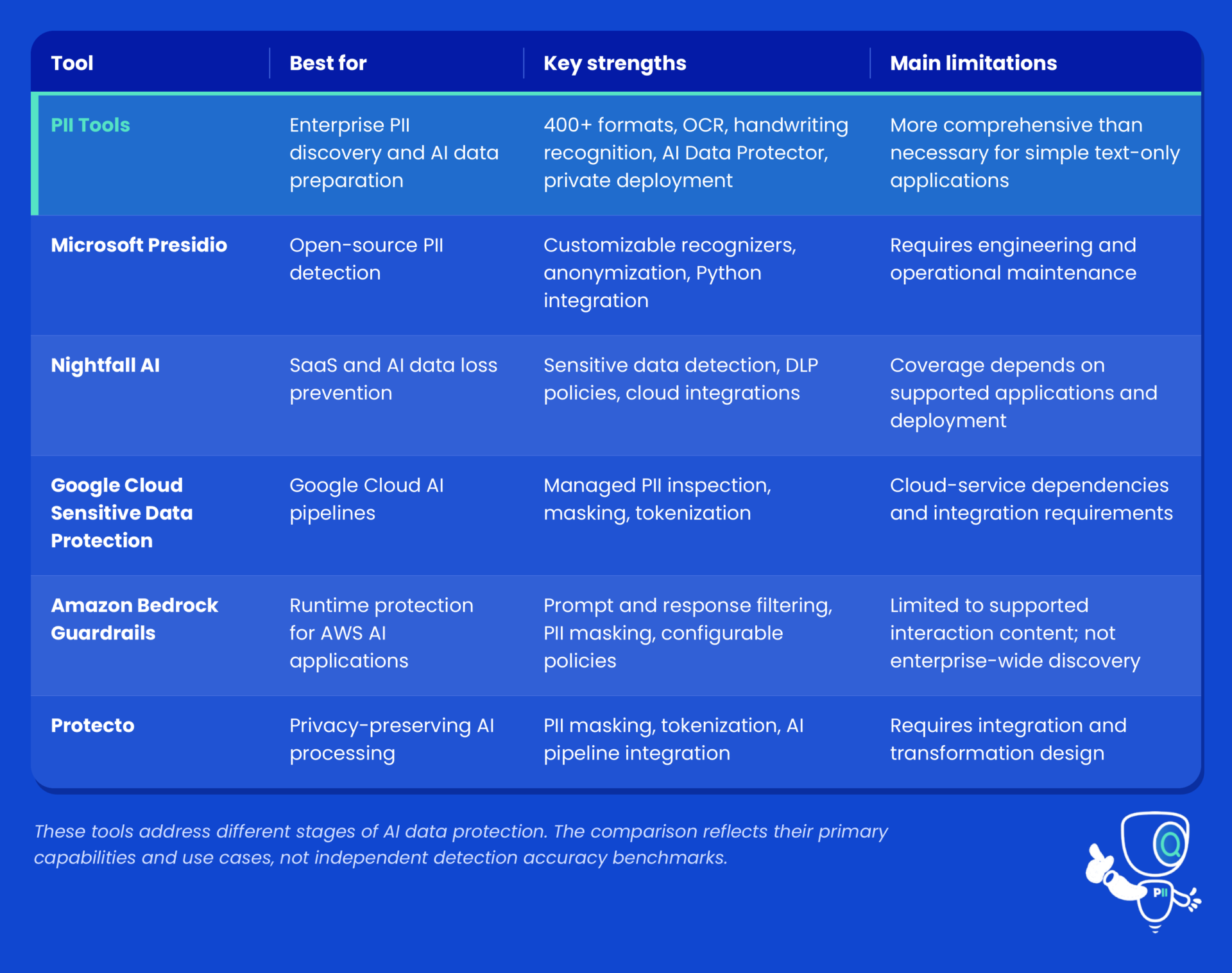
Different risks call for different solutions, from enterprise data discovery and anonymization to runtime filtering and data loss prevention (DLP). So which tools are best suited to the job? Let's compare six leading options, including what they do well and where they fall short.
6 Best PII Protection Tools for AI Applications in 2026
1. PII Tools – Best for Enterprise PII Discovery and AI Data Protection
Best for: Organizations preparing enterprise data for AI while maintaining air-gapped control over sensitive information.
When enterprises connect internal knowledge bases to AI assistants, sensitive information often hides in existing data: archived documents, scanned PDFs, spreadsheets, images, and handwritten forms.
PII Tools discovers and classifies sensitive information across more than 400 file formats. Its native OCR and AI Handwriting Recognition capabilities identify PII in documents that conventional text scanning may overlook.
The AI Data Protector then extends these capabilities into automated protection workflows, helping organizations identify and remediate sensitive information before it reaches downstream applications.
Key strengths:
- Enterprise-wide discovery across structured and unstructured data.
- Native OCR and handwriting recognition for scanned documents.
- AI Data Protector for automated detection and remediation workflows.
- On-premises, private cloud, hybrid, and air-gapped deployment options.
- Sensitive data classification and reporting to support remediation.
Limitations: For small applications processing only simple text inputs, a lightweight detection library may be easier to implement than an enterprise platform.
Verdict: PII Tools is particularly well suited to organizations that need to discover hidden PII, prepare safer datasets for AI, and maintain control over where sensitive data is processed.
Website: https://pii-tools.com/
2. Microsoft Presidio – Best Open-Source PII Detection Framework
Best for: Developers building custom PII detection and anonymization into AI applications.
Microsoft Presidio is an open-source framework that combines natural language processing, pattern matching, and customizable recognizers to detect and anonymize sensitive information. Developers can integrate it into LLM pipelines to inspect prompts and remove or mask personal identifiers before processing.
Key strengths:
- Open-source and highly customizable.
- Supports text detection, anonymization, and image-related workflows.
- Custom recognizers for industry-specific identifiers.
- Can run within infrastructure controlled by the organization.
Limitations: Presidio is a framework, not a complete enterprise data protection platform. Teams must build and maintain integrations, monitoring, and operational workflows.
Verdict: A strong choice for engineering teams seeking flexible, developer-controlled PII detection without purchasing a full enterprise solution.
Website: https://presidio.dataprivacystack.org/

3. Nightfall AI – Best for SaaS and AI Data Loss Prevention
Best for: Cloud-oriented organizations concerned about employees sharing sensitive information through SaaS and AI applications.
Nightfall AI uses machine learning-based detection and data loss prevention (DLP) policies to identify sensitive information and prevent unauthorized disclosure across supported cloud applications and workflows.
Key strengths:
- Automated sensitive data detection.
- DLP policies for supported SaaS and AI workflows.
- Integrations with business applications.
- Visibility into potential data leakage.
Limitations: Protection depends on supported integrations and configured policies. Organizations with strict data residency requirements should also evaluate where inspection occurs and how information is handled.
Verdict: Particularly useful for preventing employee-driven data leakage through SaaS platforms and generative AI tools.
Website: https://nightfall.ai/
4. Google Cloud Sensitive Data Protection – Best for Google Cloud AI Pipelines
Best for: Organizations building AI applications and data processing pipelines on Google Cloud.
Google Cloud Sensitive Data Protection helps organizations discover, inspect, and de-identify sensitive information. It combines predefined and custom PII detectors with data protection methods such as masking, redaction, and tokenization.
Key strengths:
- Extensive predefined sensitive information detectors.
- Custom inspection rules.
- Masking, tokenization, and de-identification.
- Integration with Google Cloud data services.
Limitations: Organizations must configure and integrate the service into their workflows while considering cloud processing, data residency, and usage-based costs.
Verdict: A practical choice for Google Cloud customers seeking managed PII detection and transformation within their existing cloud architecture.
Website: https://cloud.google.com/security/products/sensitive-data-protection
5. Amazon Bedrock Guardrails – Best for Runtime PII Filtering
Best for: Teams building generative AI applications on AWS.
Amazon Bedrock Guardrails provides configurable safeguards for AI applications, including filters that detect, mask, or block supported PII categories in prompts and model responses. Unlike enterprise discovery tools, it focuses on protecting sensitive information during AI interactions.
Key strengths:
- PII detection in supported prompts and model responses.
- Configurable masking and blocking policies.
- Custom regular expressions.
- Integration with Amazon Bedrock workflows.
Limitations: PII filtering is text-based and does not cover every application data path, including certain tool-call fields and logs. It also does not replace enterprise-wide data discovery.
Verdict: A useful runtime protection layer for AWS-based generative AI applications.
Website: https://aws.amazon.com/bedrock/guardrails/

6. Protecto – Best for AI Data Masking and Tokenization
Best for: Organizations that need AI applications to process useful information without exposing original personal identifiers.
Protecto detects and transforms sensitive information through masking and tokenization, allowing AI applications to process data while protecting original identifiers. Its approach helps preserve contextual relationships without unnecessarily exposing personal information.
Key strengths:
- PII detection and masking.
- Tokenization for privacy-preserving processing.
- Integration into AI and data pipelines.
- Protection designed around AI application workflows.
Limitations: Organizations must integrate Protecto into their workflows and determine how protected values are managed or restored. Supported deployment options and data types should be verified for each use case.
Verdict: Worth considering for AI applications where maintaining data utility while protecting personal identifiers is a central requirement.
Website: https://www.protecto.ai/
How to Choose the Right PII Protection Tool
The best solution depends on where sensitive information exists and when it needs protection.
- Before AI ingestion: If you're connecting enterprise repositories, historical archives, or document collections to AI, prioritize comprehensive discovery and remediation with solutions such as PII Tools.
- During AI processing: To inspect prompts and responses, consider Microsoft Presidio, Amazon Bedrock Guardrails, or specialized masking solutions such as Protecto.
- Across employee workflows: If your main concern is unauthorized sharing through SaaS applications and AI services, consider DLP platforms such as Nightfall AI.
- Within cloud data pipelines: When your infrastructure is primarily built on Google Cloud, its managed Sensitive Data Protection capabilities may simplify integration.
Whatever your use case, evaluate detection accuracy, support for unstructured documents, deployment requirements, and data residency. Also, make sure to test the solutions against your own datasets rather than relying solely on advertised capabilities.
To better understand the technology behind these solutions, see our guide to how automatic PII redaction tools work.
Protecting PII Across the AI Lifecycle
No single tool covers every AI privacy risk. Runtime guardrails, DLP platforms, and tokenization all play a role, but effective protection starts with knowing where sensitive data exists and controlling what reaches AI applications.
PII Tools helps organizations discover, classify, and remediate sensitive information across enterprise data environments, including unstructured documents that conventional scanning can miss. Schedule a Free Demo to see how it can help secure your AI workflows.
Frequently Asked Questions
What are the best tools for protecting PII in AI applications?
Leading options include PII Tools, Microsoft Presidio, Nightfall AI, Google Cloud Sensitive Data Protection, Amazon Bedrock Guardrails, and Protecto. The best choice depends on whether you need enterprise data discovery, runtime filtering, DLP, or data masking.
How can you detect PII in AI applications?
PII detection tools use pattern matching, natural language processing, and machine learning to identify sensitive information. They can inspect datasets, documents, prompts, and AI responses, depending on their capabilities.
Can AI applications expose personally identifiable information?
Yes. PII can enter AI systems through training datasets, employee prompts, uploaded documents, and connected knowledge repositories. Without appropriate safeguards, sensitive information may be disclosed to unauthorized users or external services.
What is the difference between PII detection and PII redaction?
PII detection identifies sensitive information, such as names, addresses, or identification numbers. PII redaction removes or obscures that information to prevent unauthorized disclosure.
How do you protect PII before using enterprise data with AI?
Start by discovering and classifying sensitive information across your data sources, including scanned and unstructured documents. Then apply appropriate remediation, such as redaction or masking, before making the data available to AI applications.
What is PII Tools?
PII Tools is sensitive data discovery software, so you can discover, analyze, and remediate PII across all your digital assets, on-premises or in your Private Cloud. Schedule a FREE DEMO and secure your PII for good!