







Key takeaways
- GLBA compliance starts with data visibility. Banks and lenders need to know where customer NPI is stored before they can effectively protect it.
- Sensitive customer information extends beyond databases. NPI can hide in emails, shared drives, scanned documents, attachments, and legacy archives.
- Automated PII discovery helps close visibility gaps. OCR, handwriting recognition, and context-aware detection help identify sensitive information that conventional searches may miss.
- Discovery must lead to action. Financial institutions should assess access permissions, apply appropriate safeguards, securely dispose of unnecessary data, and repeat discovery regularly.
- The right PII detection tool supports GLBA compliance. Look for secure deployment options, broad data coverage, accurate classification, and actionable reporting.
GLBA and Banks
Banks, mortgage lenders, and other financial institutions handle vast amounts of sensitive customer information. Loan applications, tax returns, credit reports, and scanned IDs are constantly emailed, downloaded, and stored across different systems.
Under the Gramm-Leach-Bliley Act (GLBA), protecting this information is a legal obligation. But how can you protect customer information if you don't know where all of it is stored?
This practical checklist explains how to find nonpublic personal information (NPI) in files, emails, and other repositories, assess its exposure, and use automated PII discovery to support GLBA compliance. For a broader overview of the requirements, check out our GLBA Compliance Guide.
What Customer NPI Should Banks & Lenders Look For?
Nonpublic personal information (NPI) generally includes personally identifiable financial information that consumers provide to financial institutions, or that institutions obtain through financial transactions and services.
For banks and lenders, common examples include:
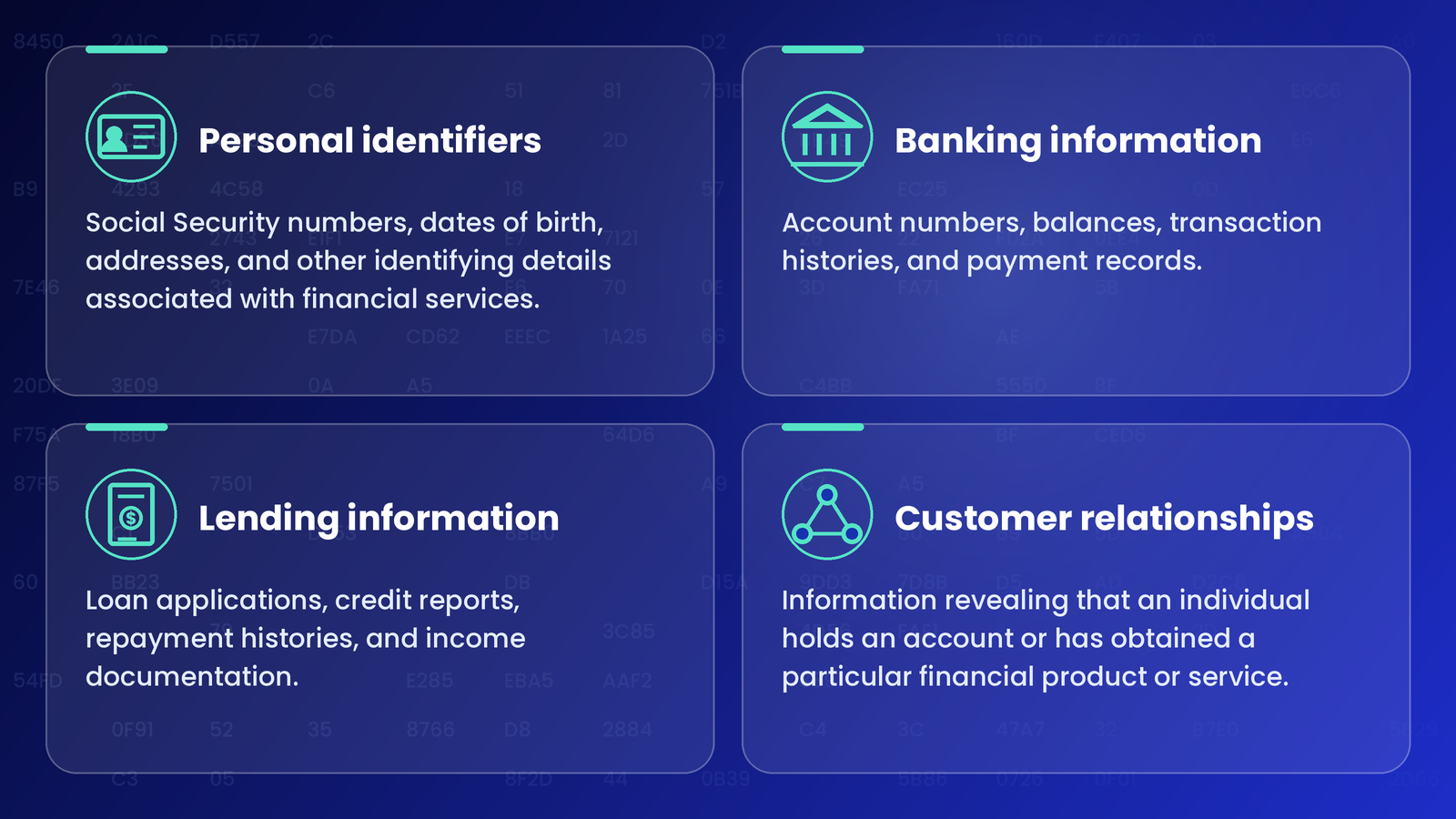
NPI and personally identifiable information (PII) overlap, but they aren't interchangeable. Financial records can qualify as NPI even without obvious personal identifiers.
That's why searching only for Social Security or account numbers isn't enough. Effective discovery must also identify financial records and contextual information that reveal sensitive customer details.
For more background on GLBA and its terminology, see our Beginner's Guide to GLBA Compliance.
GLBA Safeguards Rule Checklist: 6 Practical Steps
The following checklist focuses on discovering and protecting customer NPI as part of a broader GLBA information security program.
- Inventory all systems: Map where customer NPI is stored or processed, including databases, file servers, shared drives, email systems, cloud repositories, and document archives.
- Discover and classify sensitive data: Scan relevant repositories to identify personal identifiers and financial records. Include unstructured data such as emails, PDFs, scanned documents, and attachments.
- Assess access permissions: Determine who can access the identified information. Look for overly broad permissions, unnecessary copies, and sensitive records stored in inadequately protected locations.
- Apply appropriate security controls: Use discovery findings to prioritize safeguards such as access restrictions and encryption. The FTC Safeguards Rule generally requires encryption of customer information at rest and in transit over external networks, subject to specified exceptions.
- Enforce data minimization and secure disposal: Identify outdated customer records and determine whether they must be retained. The FTC rule generally requires secure disposal within two years of the information's last use in providing a product or service, subject to exceptions.
- Document findings and repeat discovery: Record identified risks and corrective actions, and schedule recurring scans to maintain visibility as customer information moves across systems.
How to Find NPI in Files and Emails
Customer NPI often hides in unstructured data, from emailed tax returns and scanned loan applications to archived documents and shared folders. Manually searching thousands or millions of files isn't practical, so financial institutions need automated discovery tools with specialized capabilities:
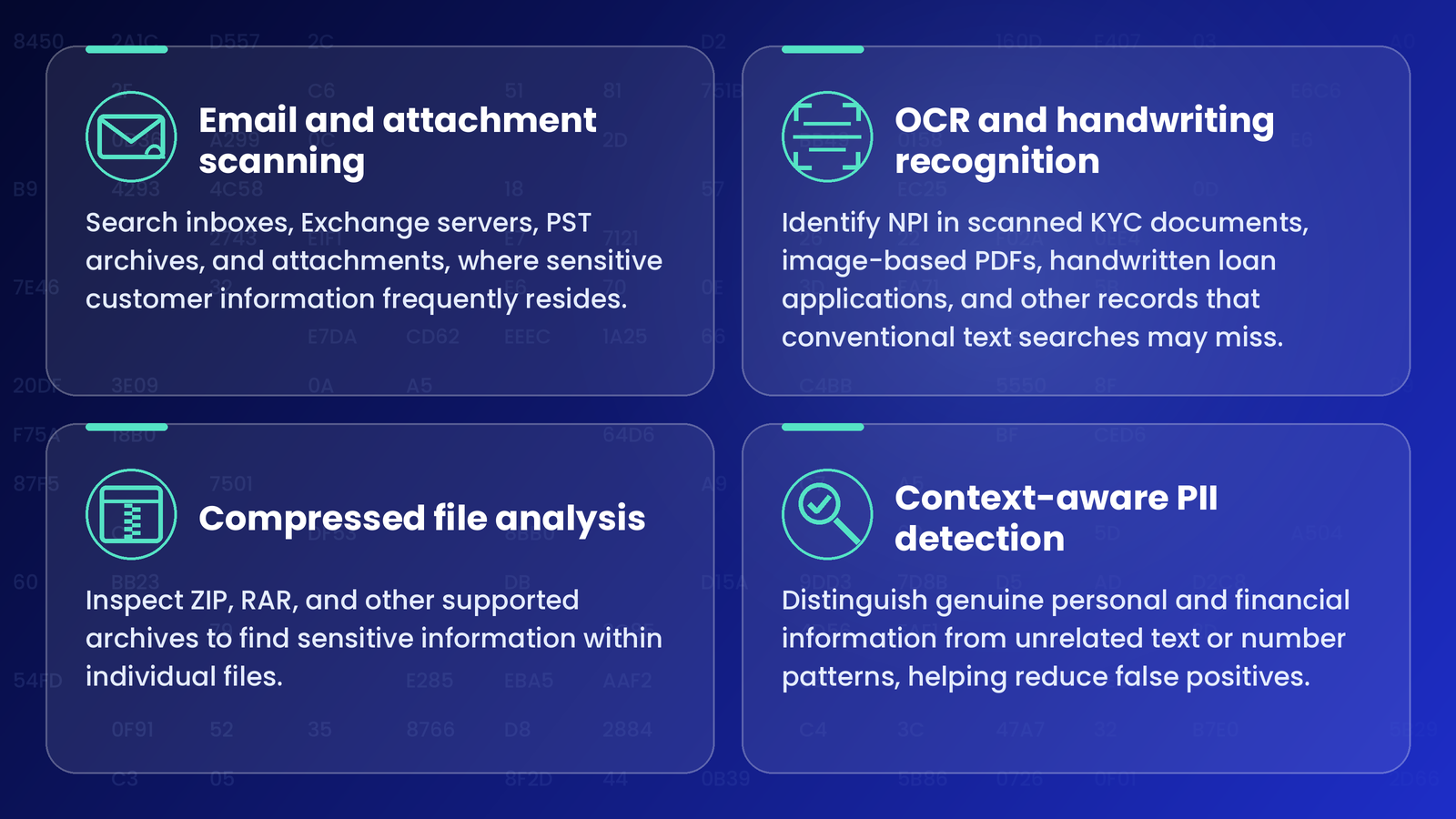
Once NPI is identified, financial institutions can use the findings to assess exposure, prioritize remediation, and strengthen access controls or data retention practices. The goal isn't just to find sensitive information, but to understand where it resides and what needs to be protected.
Best PII Detection Tool for Banks?
Banks and lenders handle highly sensitive financial information, often across complex IT environments. Generic search utilities and basic pattern-matching tools may struggle to identify customer NPI in scanned documents, legacy archives, and other unstructured data.
So, which PII detection tool is best for a bank? The answer depends on the institution's infrastructure, security policies, and compliance objectives. However, several capabilities deserve particular attention.
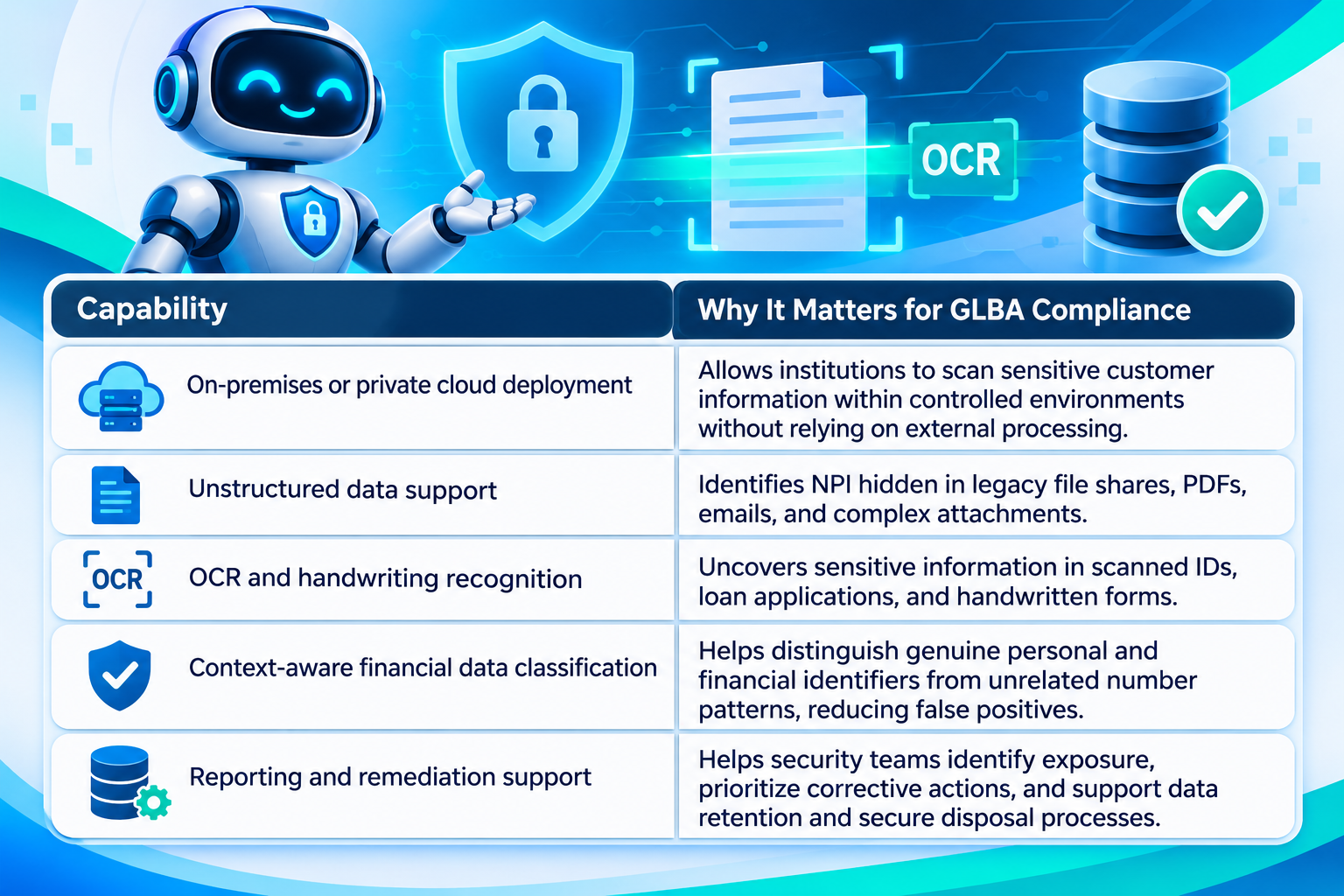
These capabilities are particularly important when customer information is scattered across multiple systems and file formats. Let's look at how PII Tools addresses these challenges in practice.
How PII Tools Supports GLBA Data Discovery
PII Tools helps banks, lenders, and other financial institutions discover and classify sensitive customer information across files, emails, databases, and document archives. Using AI-powered PII detection, OCR, and handwriting recognition, it identifies information that conventional searches may miss, including NPI hidden in scanned documents and unstructured data.
With on-premises and private cloud deployment options, financial institutions can analyze sensitive data within their own controlled environments. Detailed reporting helps security teams understand where customer information resides, assess potential exposure, and prioritize remediation.
Schedule a FREE Demo Today to See How PII Tools Will Help You Find & Protect Sensitive Customer Information.
Frequently Asked Questions
What is the GLBA Safeguards Rule?
The GLBA Safeguards Rule requires covered financial institutions to develop, implement, and maintain an information security program to protect customer information. It includes requirements for risk assessments, access controls, encryption, monitoring, and secure data disposal.
What types of customer information are protected under GLBA?
GLBA protects nonpublic personal information (NPI), which includes sensitive financial information such as Social Security numbers, bank account details, credit reports, loan applications, and transaction histories.
How can banks find NPI in files and emails?
Banks can use automated PII discovery tools to scan email systems, shared drives, databases, PDFs, and document archives. Technologies such as OCR, handwriting recognition, and context-aware detection help identify sensitive information in unstructured files that conventional searches may miss.
Does the GLBA Safeguards Rule require data discovery software?
No. The GLBA Safeguards Rule does not mandate a specific PII discovery tool. However, automated discovery can help financial institutions identify customer information, assess risks, and support the implementation of appropriate security safeguards.
Which PII detection tool is best for GLBA compliance?
The best tool depends on the institution's infrastructure and security requirements. Banks and lenders should prioritize broad data source coverage, OCR and handwriting recognition, context-aware classification, secure deployment options, and actionable reporting. PII Tools offers these capabilities to support sensitive data discovery in financial environments.
What is PII Tools?
PII Tools is sensitive data discovery software, so you can discover, analyze, and remediate PII across all your digital assets, on-premises or in your Private Cloud. Schedule a FREE DEMO and secure your PII for good!